The community that inspired our mission
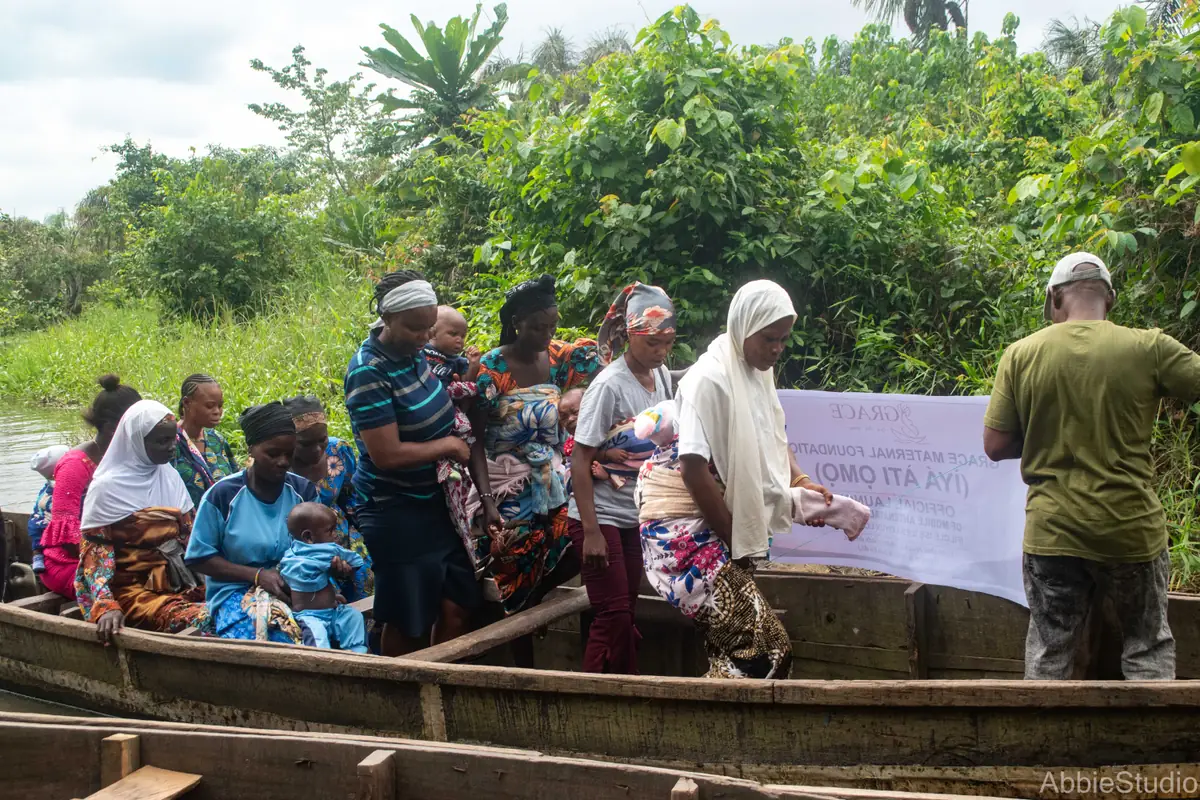
Ikogbo is a waterfront community in Ogun State where most journeys are made by boat. It is where Grace Maternal Foundation began, and where my mother left the land that carries her name forward.
There are places that almost never reach the headlines. Communities where life is quiet, but where the difficulties are hidden. Places where possibility is dictated by geography, and where access to healthcare is not only a question of whether services exist, but of whether people can physically reach them.
One such place is Ikogbo.
Ikogbo is a waterfront community in Ogun State, sharing a boundary with Lagos. It is resilient, rich in history and culture and in the strength of its people. Yet for many women, particularly during pregnancy and childbirth, daily life presents obstacles most people never have to consider.
When we first looked closely at the realities facing mothers and families in Ikogbo, one thing became obvious. Every figure is a woman who is going to give birth. Every health problem belongs to a family hoping for a safe delivery and a healthy future.
That realisation was the beginning of Grace Maternal Foundation. The Foundation did not start with a programme or a project. It started with a community whose story deserved to be heard, and with women who deserved better access to quality maternal healthcare.
A community reached by water
Ikogbo is a waterfront rural community in the Ado-Odo/Ota Local Government Area of Ogun State. Though it sits next door to Lagos, reaching it is not child's play. Most of the journey is made by boat, and the waterways are the primary route for residents, visitors and essential services alike.
Life there is built on small-scale trading, farming and local business. Families have lived in the community for generations, forming bonds and traditions that still shape daily life.
Alongside its natural beauty and communal spirit, Ikogbo carries many of the realities of a hard-to-reach rural location. Limited access to healthcare. Undeveloped infrastructure. Key public services that arrive slowly, or not at all.
For a woman who is pregnant, those conditions change everything. A journey that would be ordinary elsewhere becomes a significant undertaking. The availability of a boat, the weather, the time of day and the money in hand all affect whether she can reach an antenatal appointment or emergency care. Every delay adds uncertainty, and in pregnancy and childbirth uncertainty carries a cost.
The most striking thing about Ikogbo, though, is not its limitations. It is the determination of its people. Families look out for one another. Women care for their children in the face of considerable difficulty. Community members continue to hope for greater possibilities for the generations that follow. That tenacity deserves to be met with fair access to good healthcare.
The challenges women face
Pregnancy should be a time of optimism, support and preparation. For many women in Ikogbo it can also be a period of uncertainty.
The central difficulty is access to good maternal healthcare. For a woman in labour, or facing a complication, every minute counts. Emergency transport is often unavailable, and families make whatever arrangement they can at the time. What should be a medical emergency can quickly become a race against the clock.
Antenatal care remains just as serious a concern. Regular visits allow problems such as high blood pressure, anaemia and infection to be found before they become life-threatening. Without them, many women do not recognise the warning signs until it is too late.
Health education matters equally. Many women have not had the opportunity to learn what they need to know about pregnancy, nutrition, birth preparedness, newborn care, or the danger signs that call for immediate medical attention.
Adolescent pregnancy is a further challenge. The 2023 Nigeria Demographic and Health Survey found that 15 per cent of Nigerian women aged 15 to 19 had already begun childbearing, which underlines how much reproductive health education and support for young women is still needed.
None of these constraints exist because women lack strength or commitment to their families. They exist because access to healthcare is still not equal. Every woman, wherever she lives, deserves the chance to receive skilled care.
The human cost behind the numbers
Nigeria carries one of the heaviest burdens of maternal death in the world. According to figures from the World Health Organization, close to 29 per cent of all maternal deaths worldwide occur in Nigeria, and around 75,000 women die here each year from causes related to pregnancy. Almost all of those deaths could be prevented by timely access to good healthcare.
The World Health Organization puts Nigeria's maternal mortality ratio at close to 1,000 deaths per 100,000 live births, among the highest anywhere. Figures like these are a reminder that improving maternal healthcare is not only a medical priority. It is a matter of dignity, justice and fairness.
Statistics help us understand the scale of the problem, but they can never convey what is lost. Every maternal death leaves a family permanently changed. A newborn without a mother. A partner grieving while caring for children. A community mourning someone who mattered.
In places like Ikogbo, those losses are often shaped by care sought too late, by the absence of transport, and by the lack of skilled maternity services nearby. Ikogbo is not alone. Many riverine and hard-to-reach communities across Nigeria face the same difficulties. Their stories are a reminder that where a woman lives should not decide whether she survives pregnancy and childbirth.
Why we began here
For me, Ikogbo is more than the place where Grace Maternal Foundation began. It is personal.
My late mother, Grace, held land in Ikogbo before she died. She never had the chance to see this Foundation, or the work that now carries her name. In many ways, though, her legacy is this community too.
The land she left behind is still undeveloped, but it is far more than property. It is a reminder of what she believed, of her strength, and of the compassion that continues to drive this work.
Choosing Ikogbo as the starting point was never about convenience. It was about purpose. This community is why Grace Maternal Foundation exists. It reminds us that real change comes from listening, from building trust, and from standing with communities rather than speaking for them.
We recognise the resilience that is already there. We are not trying to rescue Ikogbo. We work with women, families, health workers and community leaders to widen access to maternal health services and to build lasting solutions together.
Every journey begins somewhere. Ours begins here.
The first chapter, not the destination
Ikogbo is the first chapter of our story, but it is not where the story ends. Our vision reaches beyond one community. We believe every woman, wherever she lives, deserves safe pregnancy care, skilled attendance at birth, and respectful maternal healthcare. No family should lose a mother because good care was too far away, or impossible to reach.
At Grace Maternal Foundation we are committed to building partnerships, supporting communities, promoting maternal health education, and reducing health inequalities through practical, community-led solutions.
Lasting change takes time. It is built through trust, through collaboration, and through a shared commitment to treating every mother with dignity.
As we begin this work in Ikogbo, we invite you to be part of it. Whether you follow what we do, share our story, volunteer, partner with us or support our programmes, your involvement brings us closer to a future where no woman is left behind.
Together we can help build communities where mothers are supported, families thrive, and every child has the best possible start in life. Because every mother deserves care that reaches her, wherever she calls home.
© 2026 Grace Maternal Foundation. All written content on this site, including blog posts and articles, is the property of Grace Maternal Foundation. This content may be shared with credit to Grace Maternal Foundation and a link back to the original page. Please do not reproduce without attribution.
Back to the journal